Most searched for brands of measuring and regulation technology






Sovik Kotelník is a fault signalling system for gas boiler rooms. Operators often ask us what must be monitored in a boiler room and why – the answer is given primarily by ČSN 07 0703 (Boiler rooms with gaseous fuel equipment). We have reviewed its requirements for monitoring and signalling and, for each one, show what is covered by Sovik Kotelník and what is not. The standard describes all requirements in several sections. The main ones are:
Author: Bc. Jaromír Bittner - Sales Representative for the SOVIK range
Problem: I have a residential building or commercial premises with gas boilers and I do not know whether it qualifies as a “boiler room” with obligations.
Standard: It distinguishes three categories according to output. Category III starts at a single boiler from 50 kW or a total above 100 kW, Category II is above 0.5 MW, and Category I above 3.5 MW. Below this threshold, it is not considered a boiler room within the meaning of the standard.
Sovik Kotelník: Below the threshold of the standard, Sovik Kotelník still makes sense as property protection (water leakage, frost, boiler outage), not as regulatory compliance. Above the threshold, it forms part of the solution – but whether it is a boiler room and what exactly it requires must be determined by the designer.
Problem: I want to know about a gas leak in time and be sure that the supply will be shut off.
Standard: The boiler room must have leak detection supplemented by an automatic shut-off valve. The system is two-stage: the first stage (1/10 of the lower explosive limit) triggers optical and audible signalling where operating staff are present, the second stage (1/5 LEL) shuts off the gas. For Category III, the standard permits a single-stage solution.
Sovik Kotelník: Covers this partially. Sovik Kotelník is the evaluation and signalling part of the system – it has separate ALARM 1 and ALARM 2 inputs and forwards the alarm. The actual gas shut-off is provided by a detector with valve assembly on the gas pipeline upstream of the boiler room, not by Sovik Kotelník. The fact that the detector “only beeps” at first is prescribed behaviour, not a fault.
Problem: Do I have to monitor CO as well, or is gas enough?
Standard: A CO detector is mandatory equipment for boiler rooms in all categories, and the inspection intervals are set by the operating regulations.
Sovik Kotelník: Covers this partially. It has CO ALARM 1 and 2 inputs and forwards the alarm. You must have a separate CO detector, and whether CO is linked to the gas shut-off valve is determined by the design and operating regulations – the standard does not directly require this.
Problem: It is hot in the boiler room and I do not know whether that is a problem.
Standard: The limit values for the first stage also include the air temperature in the boiler room – 45 °C.
Sovik Kotelník: Covers this. The temperature input monitors exceedance and reports it. Overheating usually means ventilation failure – which is why it is worth connecting it even if “you only want to monitor gas”.
Problem: The fan failed and the gas supply to the entire boiler room was shut off.
Standard: Fan operation is interlocked with boiler operation. Fan failure shuts down the boiler, and when all boilers are shut down the gas is automatically shut off. Ventilation and combustion air openings must have the prescribed minimum cross-sectional area, and the boiler room must have the prescribed ventilation rate.
Sovik Kotelník: Covers this partially. Boiler interlocking and shut-off are provided by the designed wiring, not by Sovik Kotelník. Sovik Kotelník lets you know that the boiler room is down, and via temperature and CO it can also indirectly reveal blocked grilles. It does not monitor the ventilation itself (cross-sections, ventilation rate).
Problem: The leak has cleared, but the boilers do not restart.
Standard: After the detection system has activated, operation may only be restored deliberately by the operator, never automatically.
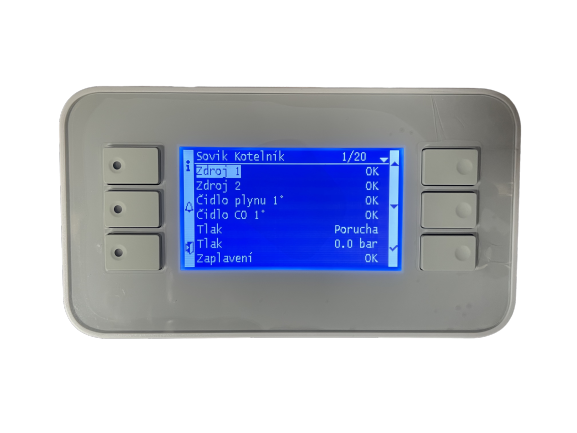
Sovik Kotelník: Covers this. It requires acknowledgement and does not have automatic reset – the most common “fault” that is not actually a fault.
Problem: Someone pressed the red button and the system cannot be started.
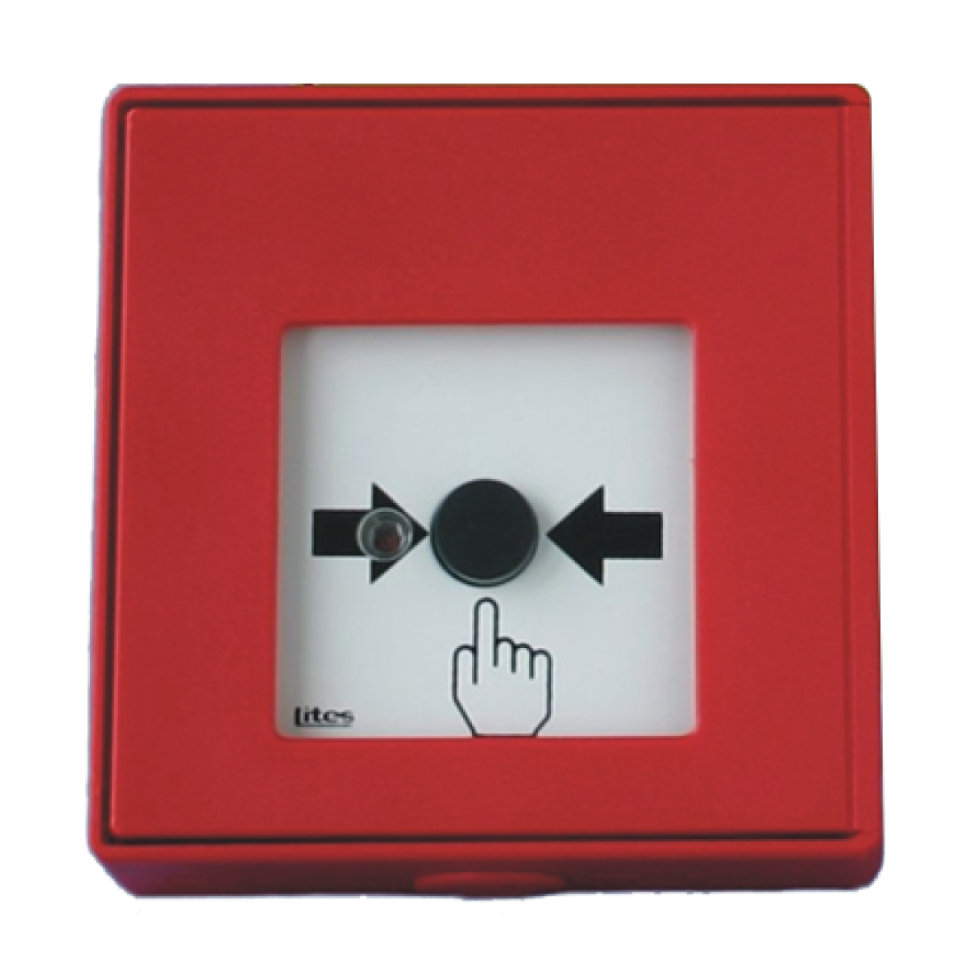
Standard: By the boiler room door there should be an emergency disconnection of the burner automation power supply operable in a single action (with exceptions, for example for boilers with their own control system).
Sovik Kotelník: Covers this partially. The button and disconnection are handled by the electrical installation; Sovik Kotelník has a Stop button input and indicates that disconnection has occurred – so you know why the boiler room is down.
Problem: I have a safety valve, so why monitor pressure?
Standard: System safety equipment consists of a safety valve, expansion vessel and monitoring of pressure limits – each element for a different condition (ČSN 06 0830, to which ČSN 07 0703 refers).
Sovik Kotelník: Covers this. The safety valve only opens when it is already too late; Sovik Kotelník can also detect a pressure drop – i.e. water leakage – before the system draws in air or freezes. For a small boiler room, this is often the main reason for purchasing it.
Problem: There is nobody in the boiler room, so who should it be reported to?
Standard: First-stage signalling should be visible and audible where operating staff are present; the standard also takes into account boiler rooms without permanent attendance.
Sovik Kotelník: Covers this. It forwards alarms by SMS and to a mobile and desktop application, both locally and remotely. Whether this fulfils the requirement for your boiler room must be assessed by the designer or inspection technician.
Problem: What if the detector or alarm device fails?
Standard: The operating regulations must address emergency conditions including signalling failure, detector failure and gas leakage. Following amendment Z1 (2006), detector inspection is governed by the manufacturer’s instructions and the operating regulations, not by the original monthly interval.
Sovik Kotelník: Covers this partially. It reports its own fault – a silent watchdog is worse than none at all. Regular detector inspections and the operating regulations remain the operator’s responsibility.
Sovik Kotelník covers the monitoring, evaluation and signalling of operating conditions. The gas shut-off valve, detectors, ventilation, electrical installation and operating regulations are dealt with by the boiler room design – exactly what your boiler room requires must be assessed by the designer or inspection technician.
| Monitored variable / element | Included in the basic SOVIK set | Requires additional purchase | Legislative requirement (ČSN / TPG) |
|---|---|---|---|
| Room and system temperature | Yes | – | ČSN EN 12828+A1 |
| System pressure and flooding | Yes | – | Operational safety |
| Gas leak detection (methane / LPG) | No | EVIKON E2630-LEL detector | TPG 908 02 / ČSN 07 0703 |
| Carbon monoxide (CO) detection | No | EVIKON E2630-CO detector | TPG 908 02 / ČSN 07 0703 |
| Emergency gas shut-off | No | PEVEKO valve | Mandatory for Category I and II boiler rooms |
Sovik Kotelník provides evaluation and signalling. The detectors and gas shut-off valve are separate components connected to the signalling system; the scope for a specific boiler room is determined by the designer.
 Bola.cz