Most searched for brands of measuring and regulation technology






When choosing a filter, it is essential to consider whether you live in a detached house or a flat. While flats usually have mains water supplied by the water utility, detached houses often draw from private boreholes or wells – these sources differ significantly in both composition and potential risks. It is also necessary to take into account differences in the pipework, such as water pressure, flow rate and other parameters. In this article, you will find out what to focus on when selecting the right filtration system.
Choosing the right domestic water filter is never a one-size-fits-all decision. Solutions for flats and detached houses differ in two key respects:
Type of filtration – water from private sources usually contains mechanical impurities, dissolved chemicals and biological contamination. With mains water, the main issues are typically chlorine and hardness. It is therefore necessary to choose the appropriate types of filters for flats and detached houses.
Technical parameters – in apartment buildings, residents cannot freely alter the pipework, so more compact filters installed at a specific point of use are more suitable. In detached houses, this is possible, and filters are typically installed at the inlet. Central water filtration has a much higher flow rate and makes it possible to treat water for the entire house.
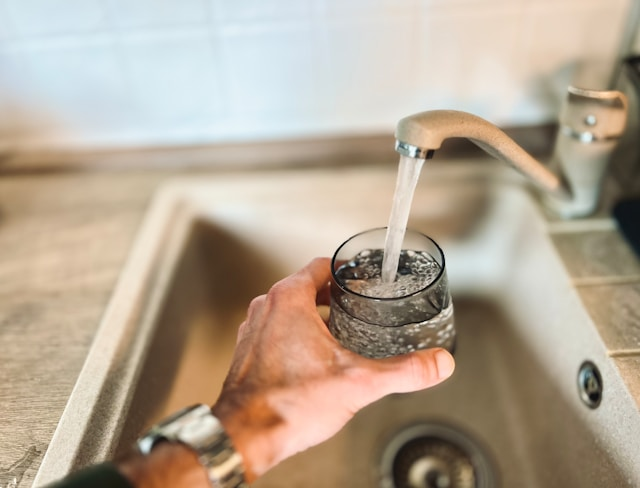
Water from the public mains and from private sources differs in composition and potential risks
In the vast majority of cases, flats are supplied with water from the public mains. This water is safe for health and strictly monitored. So you do not need to worry about microbiological or chemical contamination. Even so, this water typically has two drawbacks: a higher mineral content and the presence of chlorine, which, in addition to negative health effects, also worsens the smell and taste of the water. Activated carbon can deal with this.
Activated carbon filters remove not only chlorine, but also residues of certain other undesirable chemicals. In addition, they improve the taste and smell of the water. You can choose a filter jug, a tap water filter or an under-sink filter. What are the advantages and disadvantages of these options?
This type is installed directly on the tap without any modification to the pipework. You can fit it yourself in just a few minutes. This makes it a quick and inexpensive solution that may be suitable as a first step or for rented accommodation. However, it is not sufficient for long-term, highly effective filtration.
This is the most effective drinking water filtration system for a flat. It is installed under the kitchen sink, so it does not get in the way. Installation involves modifying the pipework, so it is not a suitable solution for tenants.
It has limited efficiency and capacity. It can be a useful supplement or a solution for travelling.
|
|
Filter jug |
Tap filter |
Under-sink filter |
|
Approximate capacity |
2–3 l |
900–1500 l |
4000–10000 l |
|
Advantages |
Portable, no installation required |
Instant installation, lower price |
High efficiency, long service life, minimal maintenance |
|
Disadvantages |
Low capacity and lower efficiency |
May get in the way on the tap, limited efficiency |
Requires space under the kitchen unit, higher price and more complex installation |
|
Installation |
None |
Easy, can be done yourself |
More complex, including modification to the pipework; requires professional installation |
|
Suitable for |
Tenants |
Smaller households |
Demanding users, larger families |
|
Approximate price |
CZK 300–1,000 |
CZK 500–2,000 |
CZK 2,500–10,000 |
Table: Comparison of water filters for flats
Still not sure which filter to choose? Our specialists will design a tailored system for you. Do not hesitate to contact us at poptavky@bola.cz or 311 257 435.
If you live in a detached house and draw water from a private source, filtration requires a more comprehensive approach. The key is central water filtration at the inlet, which can then be supplemented as needed with additional local water filtration and treatment systems.
For water from a well or borehole, this is the foundation. Filters at the inlet clean all the water entering the distribution system, thereby protecting both your health and your appliances.
A water filter at the inlet usually includes:
a pre-filter to capture larger mechanical impurities,
a fine mechanical impurity filter,
an activated carbon filter, which binds undesirable dissolved substances.
A filtration system configured in this way is usually installed in an inspection chamber or utility room. Important selection parameters are flow rate and the type and size of the connection.

Filtering well water requires a comprehensive approach
Water is considered hard when it contains an increased level of dissolved minerals, specifically a Ca²⁺ and Mg²⁺ concentration above 2.5 mmol/l. Hard water causes limescale, which damages the boiler and appliances, creates unsightly deposits on taps, and reduces the effectiveness of cleaning agents and detergents. Softening hard water is a solution that pays off financially.
Water softeners usually work on the principle of ion exchange, i.e. replacing dissolved calcium and magnesium ions with sodium ions. The reaction is enabled by salt, which must be topped up in the softener regularly.
Water from shallow dug wells often does not meet hygiene standards and tends to be prone to contamination. It usually contains elevated levels of iron, manganese, sand and silt, as well as hazardous chemical, microbiological and organic contamination. For this reason, it is more commonly used in the garden.
If you still decide to bring well water into the house, it is essential to carry out a laboratory analysis. This will tell you what types of contamination are present in the water and in what concentrations. Based on these results, you can then choose a suitable combination of filters and, if necessary, water disinfection as well.
Water filtration in a detached house usually requires a multi-stage system. In the case of well water, it may look like this:
Pre-filter and fine mechanical filter at the inlet to remove solid impurities.
UV lamp for water disinfection at the inlet.
Water softener for the water supply to the boiler and washing machine.
Activated carbon filter under the sink to improve the taste and smell of drinking water and remove dissolved harmful substances.
The first step when choosing a filtration method is a water analysis. If you use a private source, you can have this carried out by an accredited laboratory. If you draw water from the public mains, the relevant data will be provided by your water utility company.
In our table, you will find the most common drinking water problems in the Czech Republic, their symptoms and suitable solutions:
|
Problem |
Symptoms |
Recommended filtration |
|
Limescale on taps, in the boiler and appliances |
Water softener |
|
|
Iron / manganese |
Rust stains, metallic taste |
Iron and manganese filter |
|
Chlorine |
Odour, poorer taste |
Activated carbon |
|
Mechanical impurities |
Visible particles, turbidity |
Mechanical filter |
|
Microbiological contamination |
A slimy film may appear, but there may also be no symptoms; a well after flooding or an older borehole is particularly at risk |
UV lamp, chemical disinfection, capillary filter |
Table: The most common drinking water problems and their solutions
For drinking water from private sources, the first step is central filtration of mechanical impurities at the inlet. For this purpose, we recommend Honeywell filters, for example the fine backwashable Honeywell FF06-1 1/4AA filter with a 100 µm element and 16 bar pressure rating.
This filter cleans all the water in a detached house very effectively, ensures a continuous supply of filtered water, and offers easy maintenance.
A “3-in-1” solution is offered by the SYR POU under-sink water filter. It consists of a 20 µm fine mechanical impurity filter, an activated carbon filter for removing chlorine, chemicals and odours from the water, and a capillary filter that is effective against microorganisms and bacteria.
With a flow rate of 0.2 m3/h and a pressure of 10 bar, it helps to improve drinking water quality in the kitchen. It is a compact solution suitable for both flats and detached houses with a good-quality water source, or with a pre-filter at the inlet.
If you are looking for a water softener, we offer solutions for detached houses, flats and smaller commercial premises from the leading Honeywell brand. The top-quality Honeywell KaltecSoft water softeners have an approximate capacity for 7, 15 or 21 people.
For a no-obligation consultation regarding your requirements, do not hesitate to contact us. Our specialists are available at poptavky@bola.cz or 311 257 435.
If you cannot modify the plumbing, a tap filter or a filter jug is a suitable choice. A tap filter is installed directly on the tap without any building work and helps remove chlorine while improving the taste of the water. A filter jug is the simplest option, but it has lower capacity and efficiency.
You can recognise hard water by limescale on taps, the kettle or other appliances. Other signs may include higher consumption of detergents and cleaning products or poorer soap lathering. A water analysis or information from your water supplier will give you certainty. If the water hardness is high and causing problems, a water softener may be a suitable solution.
It depends on your requirements and the amount of water to be filtered. A tap filter is an affordable solution for improving taste and removing chlorine, especially suitable for smaller households or rented accommodation. An under-sink system offers higher capacity, longer filter cartridge life and usually more effective filtration, so it is worth it for regular everyday use.
 Bola.cz


