Most searched for brands of measuring and regulation technology






Pressure gauges have a very wide range of applications. From heating systems and domestic water pumps to production technology and boiler rooms. They are therefore an essential part not only of households, but also of industrial operations and commercial buildings. Two basic types of pressure gauge are available on the market: digital and mechanical. When is it worth investing in a digital solution, and when will a mechanical pressure gauge be sufficient?
Correct and stable pressure is key to the safe and efficient operation of water and gas systems. Pressure monitoring allows you to optimise their operation and detect potential faults in good time, especially gas and water leaks or pipeline failures.
At the same time, measuring water pressure helps you prevent undesirable fluctuations in systems. Vacuum causes system damage, air ingress and the associated corrosion, while overpressure causes water or gas leaks, cracks and breakdowns.
Vacuum and overpressure are measured using manometers, i.e. pressure gauges, which measure the pressure of a liquid or gas in closed pipework systems, heating systems, water distribution, boilers, pressure vessels or various industrial equipment.
However, old pressure gauges often do not offer sufficient accuracy and reliability. Replacing measuring equipment is therefore an important step towards improving safety and efficiency.
Currently, you will encounter mechanical and digital pressure gauges on the market, each offering users different benefits.
You can easily recognise an analogue pressure gauge by its classic dial with a pointer that displays the measured values. There are various pressure sensing technologies; the most common include:
Mechanical pressure gauges have a lower purchase price and are more robust, and they do not require a power supply. Their disadvantage, however, is lower accuracy and susceptibility to wear. They are a suitable solution for households as a pressure gauge for a domestic water pump or heating system; glycerine-filled pressure gauges can also be used for industrial technology.
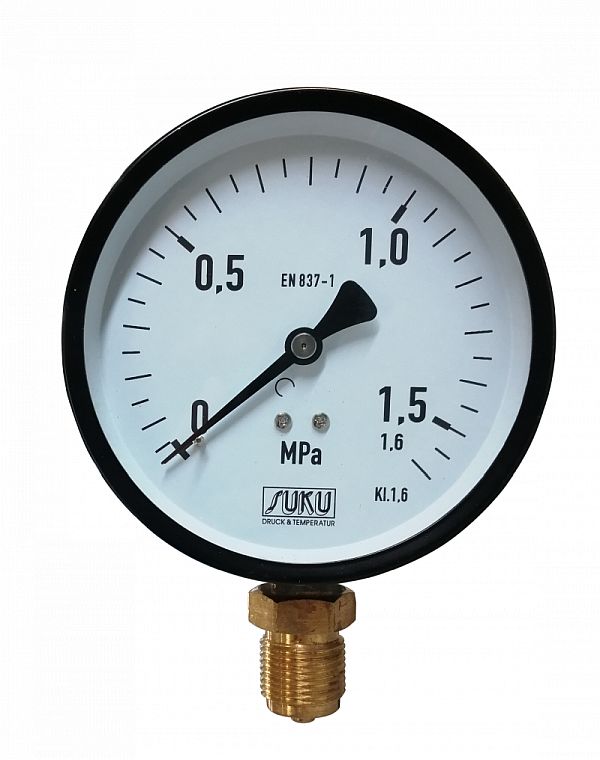
Simple and reliable SUKU pressure gauge
Digital pressure gauges contain sensors whose signal is digitised and processed by a microprocessor. The measured values are displayed on a screen. Compared with mechanical pressure gauges, they offer higher accuracy and measurement stability and, depending on the specific model, various useful functions, such as:
The disadvantages of digital pressure gauges are their higher price and the need for a power supply, so when choosing it is advisable to assess the requirements of the specific application. Digital pressure gauges are suitable for demanding industrial applications where continuous pressure monitoring and retrospective checking are important, as they can be connected to industrial computers and data collection can be automated.
In addition to the type, when choosing a suitable pressure gauge you must consider several other parameters, in particular the pressure range and measurement accuracy. Also take into account the operating conditions, i.e. temperature and humidity, and if necessary choose a pressure gauge with a sufficient IP rating. If the pressure gauge is used in a hazardous environment or with explosive media, it must have the relevant certifications, as must pressure gauges for drinking water.
For correct installation and convenient reading, also consider the pressure gauge dimensions, connection type and installation method. For digital pressure gauges, power supply and additional functions are also important criteria.
In our range you will find high-quality pressure gauges from the leading measuring technology manufacturer SUKU for various media and applications. We also offer all accessories for safe and accurate pressure measurement – condensation loops, pressure gauge valves and shut-off cocks. We will also be happy to arrange calibration and servicing of pressure gauges.
If you are looking for a specific solution or digital pressure gauges, do not hesitate to contact us. We will prepare an individual, tailor-made proposal to suit your needs.
 Bola.cz