Most searched for brands of measuring and regulation technology






Ultrasonic heat meters are becoming increasingly popular thanks to their accuracy and features. However, choosing a high-quality meter is not enough – correct installation is crucial. A number of factors can affect ultrasonic measurement, and these must be eliminated. This will help you avoid inaccuracies in heat measurement, complaints and heat losses.
To install and position an ultrasonic heat meter correctly, it is necessary to understand how this technology works. Two ultrasonic transducers transmit ultrasonic waves with and against the direction of flow. These waves speed up in the direction of flow and slow down in the opposite direction.
The meters measure the transit time of the ultrasonic waves through the heating water between the transducers. These times differ with and against the flow. From the difference between these times, the meter determines the flow rate accurately. Based on the flow rate and the temperature difference between the flow and return, it then calculates heat consumption.
Thanks to advanced technology and features, ultrasonic heat meters are used mainly in central heating systems in residential buildings, administrative buildings and industrial complexes. The measured data is used not only for accurate cost allocation, but also for optimising heat distribution.
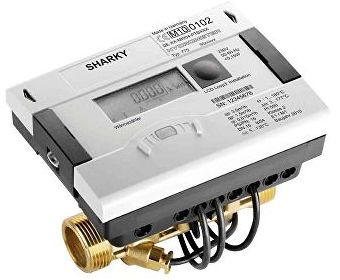
Enbra ultrasonic heat meter
Correct installation and deviation-free heat measurement starts with selecting the right meter. When choosing, you must take into account in particular:
You also need to know at the selection stage whether you will install the meter on the flow or return pipework, and whether it will be on horizontal or vertical pipework. These settings are fixed and must be adhered to.
Last but not least, for billing purposes the meter must have MID certification. Reputable manufacturers of ultrasonic heat meters include Enbra, Siemens, Kamstrup and Qundis.
As mentioned, depending on the meter model it is necessary to comply with installation either on the flow or return pipework. Ultrasonic heat meters are manufactured for both types of installation; however, the return pipework is more advantageous due to lower thermal stress and more stable parameters. It is also necessary to comply with the position specified by the manufacturer, i.e. either horizontal or vertical (usually on risers). Do not forget that the meter must be easily accessible for reading, installation and maintenance.
Ultrasonic meters are more sensitive to flow profile, turbulence and the cleanliness of the medium. Therefore, when choosing the location you must also take into account valves and fittings, filters and pumps.
In all cases, the manufacturer-specified straight (calming) length of pipe must be maintained between the meter and any valve/fitting, filter or pump.
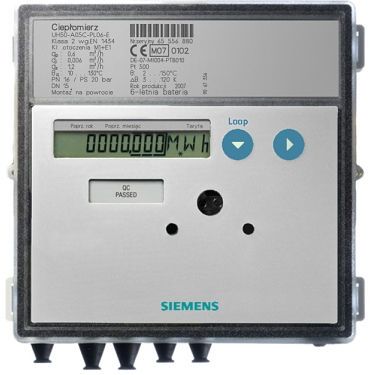
Siemens ultrasonic heat meter
The installation of heat and cooling meters, their maintenance and regular calibration may be carried out exclusively by persons authorised by the Czech Metrology Institute (ČMI) or authorised technicians. Before installation, we recommend:
Meters are always installed in the direction of flow of the heat transfer fluid, which is indicated on the meter by an arrow. First, shut off the water supply and drain the pipework. Then install the flow body into the pipework according to the type of connection (flange, thread, etc.) and fit the temperature sensors. Connect the temperature sensor cables to the calculator unit. Connect the meter to the power supply (battery or mains). After installation, it is necessary to carry out pressure and leak tests, switch on and check the calculator unit.
Finally, record the basic details such as initial readings, serial number and installation date. Fit the required seals and hand the meter over to the customer together with the report. The exact installation procedure may vary slightly depending on the manufacturer.
Remote readings are becoming increasingly popular today – they save time and money, and also minimise the risk of human error. If a communication module is included in the supply, simply mount it on the meter according to the instructions. You then configure it using service software.
If you need advice on selecting, positioning or installing an ultrasonic meter, please do not hesitate to contact us. Our specialists will be happy to provide free consultations and design a tailored metering system.
 Bola.cz