Most searched for brands of measuring and regulation technology






Summer is the ideal time for maintaining and upgrading industrial machinery. Are you also considering optimising automation systems and pneumatic actuators? Read our article to find out how to size them correctly for efficient, trouble-free operation.
Pneumatic actuators are used to open and close various systems in industry and buildings. As they operate on a mechanical principle and contain only compressed air, they are highly versatile and safe for people and the environment. They are used in industrial automation, for controlling assembly lines, doors, packaging and other industrial machines, in irrigation systems, and also in healthcare, agriculture and construction.
Pneumatic systems are controlled by compressed air, which is supplied to the actuator by a compressor. The actuator converts this energy into mechanical motion. Depending on the direction and manner of movement, pneumatic actuators are divided into 3 types.
A linear, or piston, actuator moves back and forth in a straight line. It is used for pushing, lifting or compressing along a straight path, e.g. inserting boxes into a packaging machine.
It moves in the same way as a linear actuator, but has no piston rod. Instead, it has a carriage outside the cylinder, driven by a magnet or a mechanical linkage inside the pneumatic cylinder. This makes the design more compact and suitable for long strokes.
Rotates about an axis, either through a defined angle (for example 90°) or continuously. One example is a rotary arm on an assembly line. It is also combined with ball valves and butterfly valves, where it is used to open and close the flow of gaseous or liquid process media.
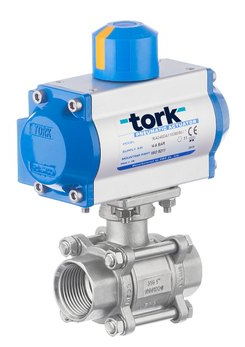
TORK pneumatic actuator with ball valve
In reality, an oversized pneumatic actuator consumes unnecessarily more air and energy. Correct sizing for the specific application is the key to efficiency and a longer service life.
Modern pneumatic systems with high-quality filtration and flow control are very quiet and energy-efficient. A properly designed system can be more reliable and cheaper to maintain than electric alternatives.
Pressure alone is not enough. It is also essential to consider piston size, air flow rate, stroke length, speed and operating conditions. Only a comprehensive calculation ensures optimal function and safe operation.
Correct sizing of a pneumatic system has a direct impact on its efficiency, accuracy and speed, as well as the service life and safety of the system. Only a pneumatic actuator with the right parameters will ensure efficient energy use, optimal operating costs and stable performance without air leakage.
An undersized pneumatic actuator does not have sufficient force and becomes overloaded, leading to more frequent failures, faster wear and a shorter service life. Oversizing, on the other hand, results in higher consumption and unnecessary costs.
In both cases, faults can jeopardise entire downstream industrial systems and may lead to production downtime, or even worker injuries. Investing in high-quality, correctly sized pneumatic actuators therefore definitely pays off.
Selecting a suitable pneumatic actuator must be preceded by a thorough analysis of the required operating parameters (especially the load) and environmental conditions. As regards the surrounding environment, you must take temperature, humidity and dust levels into account and choose an appropriate solution. If the actuator is intended for a potentially explosive atmosphere, it must have ATEX certification.
The size and nature of the load directly determine the force generated by the piston rod in N (F) that you will need. This can be calculated as the product of its effective area in m2 (A) and the air pressure differential in Pa (P): F = P × A. However, losses caused by friction, pressure drop in pipework, etc. must be taken into account.
Piston speed depends on the air flow rate and can be calculated using v = Q/A, where v is the speed, Q is the flow rate and A is the piston area. Again, individual operating conditions must be considered, such as the setting of flow control valves and the piston load; the formula above applies only under ideal conditions, and air flow calculations are influenced by a number of other factors, including air filter/regulator units.
Using these formulas, you can determine the required piston area and actuator pressure. When sizing, also consider the stroke length and the required motion dynamics so that the actuator operates reliably across the full range of operating conditions.
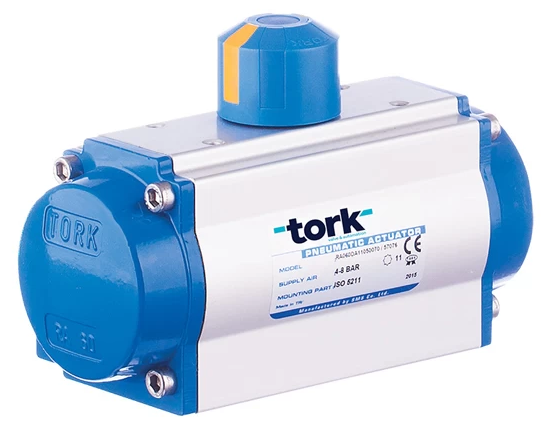
TORK double-acting pneumatic actuator
Our range includes high-quality single-acting and double-acting pneumatic actuators from TORK for a wide variety of applications. All are made from high-grade stainless steel and perform well even in demanding industrial conditions.
For example, the powerful, reliable and compact TORK T-RA60 DA double-acting pneumatic actuator is designed for fast or slow 90° rotation. It is widely used for ball valves, butterfly valves, threads or dampers. The TORK DN 40 single-acting pneumatic actuator is supplied with a stainless steel ball valve already fitted. We also offer all accessories for pneumatic actuators, such as flow control valves and air preparation filter units.
If you have any questions, please do not hesitate to contact us. We will be happy to provide free expert advice when selecting a suitable pneumatic actuator or propose a solution tailored to your needs.
A single-acting pneumatic actuator uses compressed air for movement in one direction only, with the return stroke provided by a spring. It is more suitable for simple applications.
A double-acting pneumatic actuator uses air in both directions, is more powerful and faster, and is used mainly in industrial automation, for example to operate valves, butterfly valves or industrial machinery.
Correct sizing of a pneumatic actuator means the actuator can handle the required load without difficulty, operates efficiently, without frequent failures and without excessive air consumption.
If the actuator is undersized, overloading and faster wear occur. If it is oversized, operating costs increase unnecessarily. That is why it is important to calculate the required force and air flow rate during selection.
The service life of pneumatic actuators typically ranges from hundreds of thousands to millions of cycles, depending on product quality, operating conditions and regular maintenance. For a long service life, proper filtration and preparation of compressed air, regular inspection of seals, and correct sizing of the actuator for the specific application are crucial.
 Bola.cz